MENU

Cellma’s Role in Strengthening Healthcare Revenue Cycles

In today’s UK healthcare environment, delivering excellent care goes hand in hand with managing financial performance. But it also requires accuracy, transparency, and control throughout the patient journey. Managing the various steps of billing, insurance verification, payments, and UK and global healthcare regulations is increasingly complex. Therefore, a comprehensive healthcare revenue cycle solution is no longer a luxury; it is the backbone of sustainable financial viability for modern healthcare organisations.


Cellma provides exactly that. Created specifically for the healthcare system, Cellma integrates clinical, administrative, and financial operations into a single intelligent platform. It provides visibility and control throughout your healthcare revenue cycle, from patient registration and insurance verification through to coding, billing, and claims. Each element of the process is automated and ensures validation in real time to reduce errors, speed reimbursement, and preserve financial performance. Whether for NHS trusts, private hospitals, or multi-site networks, Cellma helps organisations align clinical excellence with financial efficiency for measurable, sustainable results.


End-to-End Revenue Cycle Automation with Cellma

Starting with the first point of contact, Cellma manages all aspects of the revenue cycle in one cohesive platform. Processes covered:

Patient registration and eligibility/insurance verification at point of check-in.

Charge capture and clinical coding: When clinical encounters are recorded, Cellma captures the charge and suggests the correct code.

Claims submission and electronic remittance processing (ERA): Preparation of claims submissions, claims submission status tracking and remittance management.

Patient billing and payment collections: Creation of invoices for patients and facilities, payment plans and online payments.

Denial management & appeals tracking: Identification of claims that are denied, automation of workflows for resubmission, visibility into the denials reasons.

How Cellma integrates and works:

  • Seamless bi-directional flow of data between EHR and revenue cycle workflows: clinical documentation initiates billing events and stops duplicate data entry.

  • Real-time eligibility checks during registration to ensure correct payer information is done and captured at the front end.

  • Intelligent coding suggestions as a function of the encounter documentation to reduce coding errors and speed charge capture.

  • Automated claims-scrubbing in advance of submission to reduce denial and avoidable errors on first pass.

  • Built for UK and global compliance.

Key Features of Cellma’s Healthcare Revenue Cycle Solution

Real-time dashboards and KPI tracking

These customisable dashboards offer the ability to regularly track critical metrics, including days in accounts receivable (AR), clean-claim submissions rates, collections rates, revenue per patient encounter and revenue per clinician, outstanding patient balances, and payment trends.
Customisable views by stakeholder

The dashboards are customisable for each stakeholder. Similar to how the dashboard is customisable for the CFOs versus the finance director, it is also fully customisable for department heads and billing staff. Each stakeholder will have a unique dashboard with the assets and measures that are most aligned with their role.

Predictive analytics and revenue leakage alerts

The built-in analytics will automatically flag any patterns of high-denial rates with time in aged AR or potentially at-risk receiving revenue to allow for actionable intervention.

Audit trails for compliance

A comprehensive log of all financial transactions at the patient encounter level or visit, the coding event in the electronic health record (EHR), submissions for claims, and remittance for compliance and audit purposes.

Integrate with clinical workflow

All events for clinical workflow associate to financial elements without worrying about separate exports/imports for stand-alone spreadsheets. All financial transactions are associated with clinical events through HL7/FHIR or other control interfaces.

Workflow automation and alerting

Ageing accounts flagged automatically, follow-up tasks created, automated reminders for patient payments or insurer responses.
This collection of features means that the revenue cycle isn’t just managed – it’s visible, measurable and optimised over time.

Benefits of Cellma’s Healthcare Revenue Cycle Solution

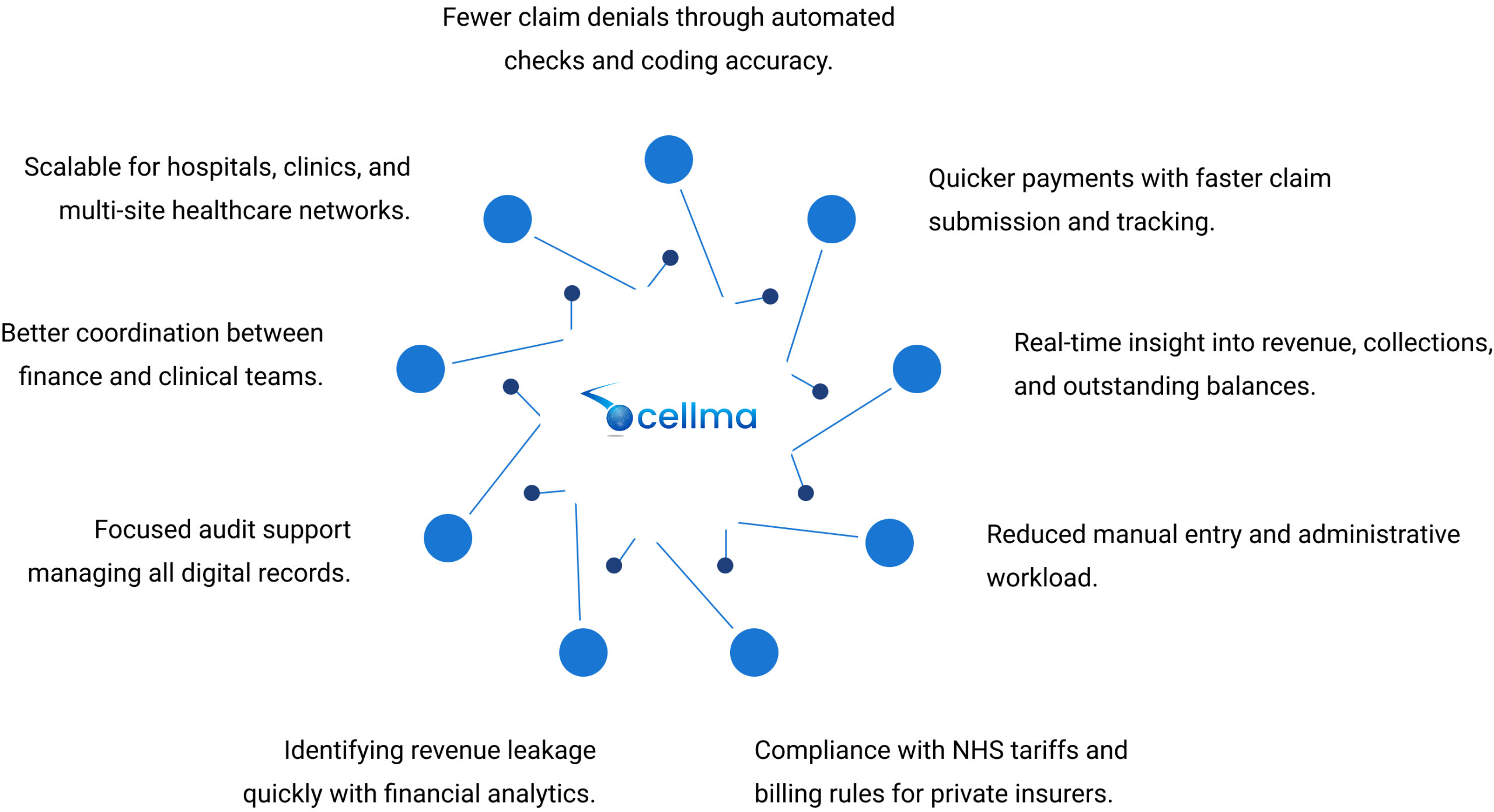
  • Fewer claim denials through automated checks and coding accuracy. 
  • Quicker payments with faster claim submission and tracking. 
  • Real-time insight into revenue, collections, and outstanding balances. 
  • Reduced manual entry and administrative workload. 
  • Compliance with NHS tariffs and billing rules for private insurers. 
  • Identifying revenue leakage quickly with financial analytics. 
  • Focused audit support managing all digital records. 
  • Better coordination between finance and clinical teams. 
  • Scalable for hospitals, clinics, and multi-site healthcare networks. 

Frequently Asked Questions (FAQs)

What types of healthcare organisations can benefit from this revenue cycle software?

Our solution is designed for hospitals, private clinics, diagnostic centres, outpatient networks and multi-specialty practices across the UK. Whether you are a single-site facility or part of a larger NHS/independent healthcare network, Cellma’s scalable platform adapts to your volume and complexity requirements.

Does the revenue cycle management software integrate with existing EHR systems?

Yes. Cellma is built to integrate seamlessly with existing systems as well as its own clinical modules. Data flows automatically between clinical documentation and revenue cycle workflows, eliminating duplicate data entry and reducing billing errors.

Can the system handle complex UK healthcare billing requirements?

Absolutely. We have built the revenue cycle module to align with UK-specific billing standards including NHS tariff structures, private insurer processes, regulatory frameworks and audit requirements. Our team keeps the system updated as the UK regulatory environment evolves.

How quickly can we expect to see improvements in our revenue cycle metrics?

While outcomes vary by organisation, many UK healthcare providers report measurable improvements within 3-6 months of implementation — including reductions in claim denials, shorter days in AR and stronger first-pass clean claim rates. A structured implementation and change-management approach help ensure these gains.


Is the software customisable for our specific billing workflows?
Yes. While we provide proven, best-practice workflows out of the box, the platform can be configured to match your existing billing workflows, departmental structures, reporting requirements and integration needs. Our team works closely with your finance, clinical and IT leads during implementation to ensure alignment and adoption.