
MENU

Cellma Ambient Voice Technology for Intelligent Clinical Documentation

Advanced Ambient Voice Technology enabling real-time clinical documentation, structured EHR records, and AI-driven workflows across NHS and global healthcare services. 

Ambient Voice Technology in Cellma for Intelligent Healthcare Workflows 
Today, the healthcare system faces higher demand for clinical services than ever before, increasing requirements for documentation from the providers; and increased demand for administrative work to be completed by clinicians. In traditional documentation processes, clinicians are required to divide their attention between caring for patients and using the computer, contributing to poor efficiency and burnout. 

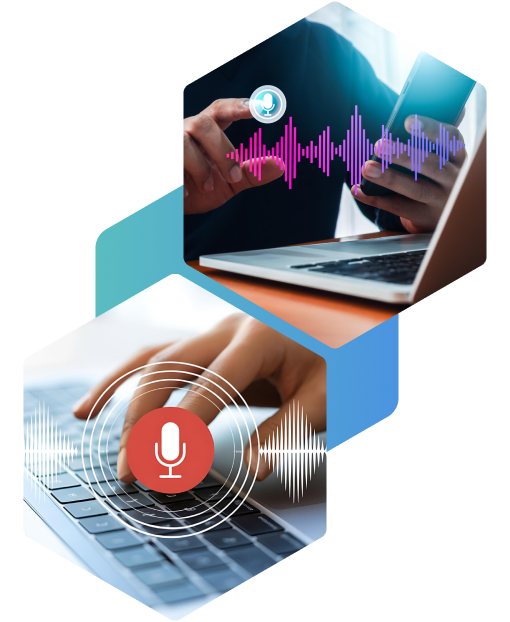
Ambient voice technology represents the next evolution of clinical documentation. Unlike simple speech-to-text tools, modern ambient platforms use natural language processing (NLP), machine learning algorithms, and contextual language models to understand clinical conversations, extract medical meaning, and generate structured electronic health records. 

Cellma integrates ambient clinical intelligence directly within the EHR environment, enabling voice AI healthcare workflows that capture clinical conversations and convert them into NLP medical documentation aligned with structured records. At the core of this capability is advanced Natural Language Processing (NLP), which interprets spoken clinical dialogue and translates it into accurate, structured electronic health records. 

Using powerful NLP models, combined with deep learning architectures, transformer models, and contextual language understanding, clinical conversations can be analysed in real time. These systems perform tasks such as clinical entity recognition, named entity recognition (NER), and clinical terminology extraction, ensuring that important medical information like diagnoses, symptoms, medications, and clinical findings are automatically identified and documented. 

By combining ambient voice technology, advanced NLP processing, and machine learning-driven language models, Cellma generates intelligent clinical documentation directly within structured EHR workflows. This approach allows clinicians to maintain natural patient interaction while the system continuously processes conversations and converts them into accurate, clinically relevant records. 

Aligned with NHS 10-Year Plan:

Cellma is purpose-built to support these goals through prevention-focused, digitally enabled, and integrated community care.

How Ambient Voice Technology Differs from Traditional Speech Recognition

Traditional Speech Recognition

Requires manual dictation commands

Limited clinical context understanding

Manual formatting of clinical notes

Minimal workflow integration

Single-speaker transcription focus

Basic speech-to-text output

Ambient Voice Technology

Passive listening during consultations

AI-driven contextual understanding

Automatic structured EHR documentation

Integrated voice-enabled EHR workflows

Multi-speaker identification (speaker diarisation)

Conversational AI with clinical data extraction

Core Capabilities of Cellma Ambient Clinical Intelligence

Ambient Listening and Speech Capture

Passively captures patient–clinician conversations using ambient listening technology, removing the need for manual dictation or keyboard entry.

Real-Time NLP and NLU Processing

Advanced natural language processing (NLP) and natural language understanding (NLU) interpret clinical dialogue to identify symptoms, diagnoses, medications, and care plans.
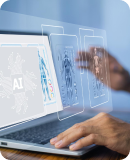
Clinical Entity Recognition and Data Structuring

AI models perform clinical entity recognition and named entity recognition (NER) to extract key medical concepts and structure clinical documentation.
Automated Medical Coding Support

Clinical conversations are converted into structured records with SNOMED CT auto-coding and ICD-10 coding support, helping standardise medical documentation and reporting.
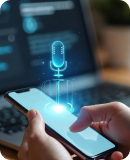
Voice-Enabled EHR Auto-Population

Captured information automatically populates voice-enabled EHR templates including consultation notes, assessments, and discharge summaries.

Predictive Documentation Assistance

Through semantic analysis, contextual embeddings, and predictive text generation, clinicians receive draft notes aligned with structured EHR workflows.
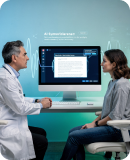
Automatic Generation of Referral Letters

Clinical consultations can automatically generate structured referral letters, reducing administrative workload and ensuring accurate communication between care providers.
Multi-Language Clinical Documentation Support

Supports multiple languages for clinical conversations and documentation, enabling accurate transcription and structured records across diverse patient populations.

Clinical Decision Support Integration

Structured data feeds clinical decision support (CDS) tools, helping clinicians identify risk indicators and support treatment planning.

Security, Compliance, and Interoperability

Built with strong governance including role-based access, encryption, audit trails, and interoperability through HL7, FHIR, and SNOMED CT standards for secure data exchange across healthcare systems.
Benefits of Cellma Ambient Voice Technology for Clinicians and Healthcare Teams

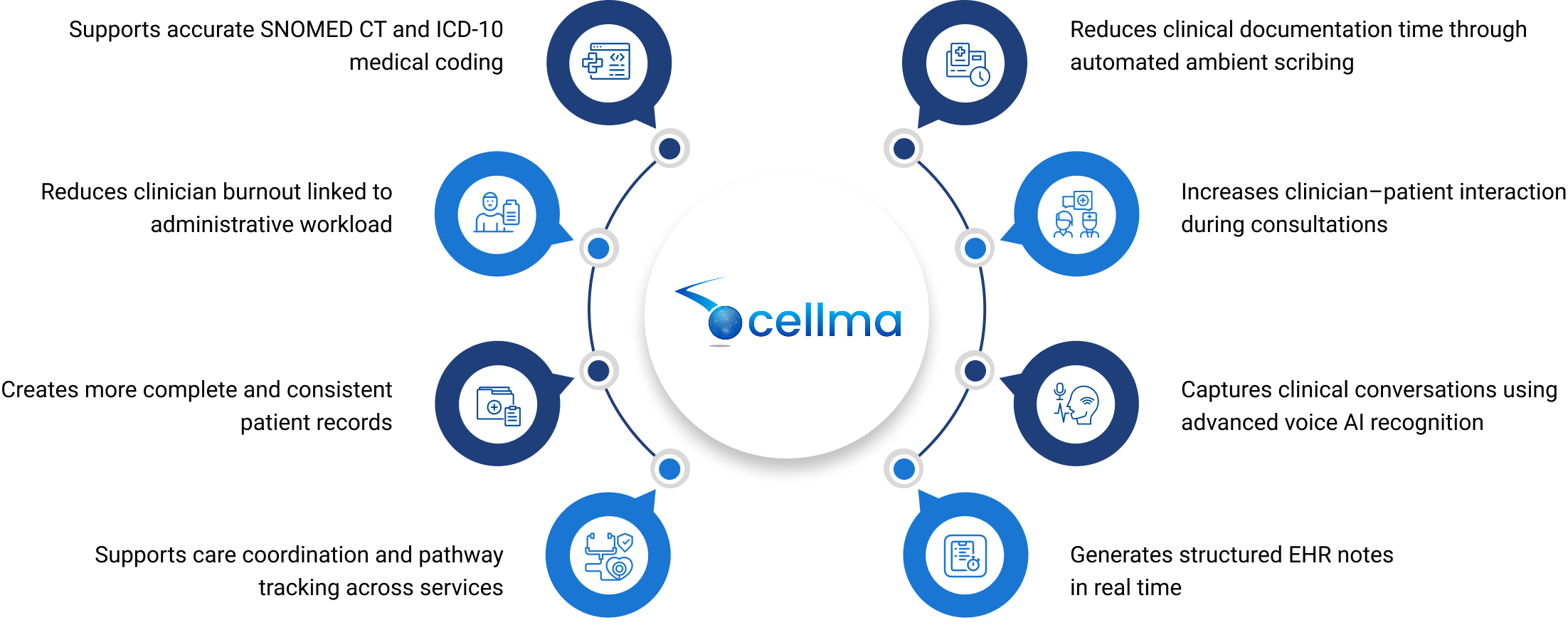
  • Reduces clinical documentation time through automated ambient scribing 
  • Increases clinician–patient interaction during consultations 
  • Captures clinical conversations using advanced voice AI recognition 
  • Generates structured EHR notes in real time 
  • Supports accurate SNOMED CT and ICD-10 medical coding 
  • Reduces clinician burnout linked to administrative workload 
  • Creates more complete and consistent patient records 
  • Supports care coordination and pathway tracking across services 

Choosing the Right Ambient Voice Technology Solution with Cellma

Transform Clinical Documentation with Cellma

Smart Clinical Documentation Workflows

Ambient voice technology is integrated into structured electronic health record (EHR) workflows through Cellma. By capturing clinician-patient conversations and converting them to clinical documents in real-time, manual typing has been minimized. Clinicians can now focus on providing patient care and having complete and structured records.

Connected and Interoperable Digital Infrastructure

Cellma supports secure interoperability via HL7, FHIR, SNOMED CT, and ICD-10 standards to ensure that clinical data can be exchanged seamlessly between clinical systems. This ensures the clinical documents produced via voice-enabled EHR workflows are available to everybody across all departments and care pathways at all times.

Data-Driven Healthcare and Clinical Insights

The structured clinical documents produced through ambient voice technology provide healthcare organisations with advanced analytics, reporting, and clinical decision support. It gives healthcare executives/leadership real-time visibility into clinical activity, clinical documentation trends, and performance of the delivery of care; all of which help them make informed decisions.

Integration with NHS Systems and Global Digital Infrastructure 

Cellma Virtual Care Solutions are built for interoperability, ensuring smooth integration with national and international healthcare systems: 

UK Healthcare Integration 

Fully aligned with the NHS 10 Year Plan, supporting its vision for integrated, patient-centred, and digitally enabled care over the next decade. 

Global Healthcare Integration 

Built for global healthcare, enabling connected, patient-centred, and digital-first care anywhere in the world. 

This ensures that Cellma is not only NHS-compliant but also adaptable to global digital health
infrastructures, making it a future-ready choice for healthcare providers anywhere. 

Frequently Asked Questions (FAQs)

Is ambient voice technology GDPR compliant for NHS use?
Yes. When deployed within compliant platforms such as Cellma, ambient voice technology follows GDPR requirements, NHS Digital governance frameworks, secure encryption protocols, and full audit trails to ensure safe clinical documentation.
How does ambient voice technology support clinicians?

Ambient systems use NLP medical documentation, clinical voice recognition, and AI processing to automatically capture consultations and generate structured EHR notes, reducing documentation workload.

Can ambient voice technology integrate with existing EHR systems?
Yes. Modern voice-enabled EHR platforms such as Cellma integrate ambient voice technology using interoperability standards like HL7 and FHIR, enabling seamless integration with existing clinical systems.