Help Others Discover – Click to Share!
As global healthcare systems continue to evolve, EHRs and EMRs are transitioning into a next phase by 2026, where simply digitising a record or adhering to government regulations for compliance no longer serves as a metric for success. In the UK, this evolution aligns with the emerging 10-Year Health Plan, which position interoperable, digitally enabled systems as central to future care delivery.
What really matters now is how well these systems back up intelligence-led care, connect everything in the healthcare ecosystem, and keep up with the nonstop changes happening in clinical and operational settings.
Healthcare data isn’t just growing, it’s exploding. Every year, there’s about 36% more of it, and soon we’ll pass 10 zettabytes. The main reasons? More digital diagnostics, remote monitoring, genomics, and a big push toward virtual care. Electronic health records are everywhere now. Close to 80% of providers around the world have gone digital. In parallel, the UK NHS alone records over 1.6 million patient interactions every day, reflecting the scale at which digital systems must perform. That’s the kind of volume the digital systems need to handle, day in and day out. As 84% of healthcare organisations worldwide see that interoperability is essential in bettering how healthcare is delivered to patients, the 2026 trends in Electronic Health Records (EHRs) indicate a movement away from traditional static record keeping toward adaptive, intelligent health platforms.
AI and machine learning aren’t just buzzwords anymore; they’re quickly turning into the backbone of modern EHRs all over the world. AI is now at the core of the majority of clinical process flows, from predictive risk modelling in North America, through population health analytics in Europe and Asia-Pacific. The NHS in the UK has made it an organisational priority to promote the responsible use of AI. The NHS 10-Year Plan explicitly highlights AI as a critical enabler for early diagnosis, workforce efficiency, and personalised care, supporting its wider shift toward digitally enabled, preventative healthcare. The global healthcare AI marketplace continues to grow as many systems are moving towards utilisation of real-time insights and automation – solidifying AI as a key future component of both EHR and EMR.
Why It’s Important
Healthcare organisations worldwide produce enormous amounts of data; however, healthcare providers typically do not have sufficient time or tools to analyse and interpret this data effectively. Globally, AI-enabled EHRs assist in providing contextually relevant information, identifying risks in real time and facilitating supportive, proactive and preventive decision-making across multiple aspects of healthcare delivery. For the NHS, this is vital to managing rising demand and workforce pressures while delivering safe, consistent care at scale.
Cellma’s Perspective
With Cellma’s platform which is built to support global healthcare systems and UK NHS, you can leverage artificial intelligence and machine learning to generate insights from healthcare datasets using smart alerts, analytic tools, and customisable workflows, allowing you to provide data-based patient care with a level of transparency and clinical responsibility.
The explosive growth of ambient voice technology throughout the world has happened due to clinician exhaustion from excessive amounts of documentation. The ambient clinical intelligence and AI voice technologies generated over $1 billion USD in the year 2024, showing strong demand and use throughout the UK NHS, US, Europe and Asia. Studies confirm that clinicians can save between 20 and 50% on time spent documenting and also save up to 70% of the time previously spent documenting beyond their regular working hours. In the UK, NHS guidelines and procurement frameworks encourage and guide clinicians in their efforts to implement ambient voice technology. Many countries have developed similar regulatory structures supporting the development and adoption of ambient voice technology.
Why it’s important
As reducing the amount of time spent on clinical documentation is an important part of physician wellbeing and patient care, enhanced data quality and enhanced patient care should continue to be the primary goals of all the healthcare systems in the world. For the UK NHS, this is especially important to reduce clinician burnout, protect patient-facing time, and sustain care quality amid rising demand and workforce pressures.
Cellma’s Perspective
Cellma provides an interface for securely utilizing ambient voice technology as an integral part of the electronic health record (EHR) interoperability process and supports responsible adoption of ambient voice technology while maintaining the patient’s safety and security.
As a result of the global trend toward moving care closer to population centres, place-based or community-led care models are developing rapidly around the world. One example of this direction in the UK is the NHS 10 Year Plan, which outlines plans to implement integrated, place-based healthcare in 42 neighbourhood health hubs throughout England. These neighbourhood health hubs combine primary care, community services, mental health, and prevention into one service within the neighbourhood itself. Similar approaches have emerged across Europe, Australia, and the Asia Pacific region, establishing neighbourhood care as a key contributor to the direction of global EHR Trends in 2026.
Why its important
Neighbourhood care requires an integrated, digitally supported approach to health records. In order for EPRs to allow for the real-time sharing of individual patient data, multidisciplinary care coordination through shared digital infrastructures, and the analysis of populations at the neighbourhood level, EHRs must not be limited to siloed systems. Silos will impede the efforts of care coordinators to work together effectively, thereby undermining the impact of coordinated care on the entire health system. For the NHS and globally, they support efficient, population-focused care and reduce health inequalities. Seamless electronic patient record integration ensures continuity and safety in virtual care. In the NHS and worldwide, it expands access, improves efficiency, and maintains care quality.
Cellma’s Perspective
Cellma’s modular and interoperable design supports neighbourhood-based care and virtual wards by enabling shared records, role-based access, and integrated reporting across organisations and care settings. This ensures seamless collaboration, continuity of care, and effective management of patients both in the community and remotely.
Interoperability is now a universal requirement. All over the world, standards like FHIR are now a must for secure data sharing between different providers, regions, and technologies. In the UK, Integrated Care Systems rely on shared care records, reflecting a broader global push toward connected ecosystems within electronic medical records systems. The NHS 10-Year Plan emphasises interoperability as a cornerstone for connected care, highlighting the integration of the NHS App with EHRs to give patients seamless access to their records, appointments, prescriptions, and care plans. This reflects a broader global push toward fully connected ecosystems within electronic medical records systems.
Why it’s Important
Without interoperability, patient data remains fragmented, leading to duplicated tests, delays, and clinical risk. For the NHS, interoperable systems are essential to enable integrated care systems, shared care records, and seamless NHS App access that supports coordinated, safe, and efficient care at scale. Connected systems are essential for safe, efficient, and coordinated care across all settings worldwide.
Cellma’s Perspective
In addition to providing integrated care through laboratory, imaging, prescription, and national data sets, Cellma’s care delivery model also enables flexibility in how providers deliver connected, continuous care throughout different geographical locations. Cellma is designed for global and NHS interoperability. Globally, it supports standards such as FHIR, HL7, SNOMED CT, ICD-10, and LOINC to enable secure, consistent data exchange across systems and regions. In the UK, Cellma integrates with NHS App, CIS2, PDS, eRS, GP Connect, and shared care records – supporting connected care across integrated care systems.
Virtual care is now embedded across global healthcare systems, from outpatient services in the UK to virtual-first models in the US and digital health expansion across emerging markets. By 2026, telemedicine will be a routine component of care delivery rather than an alternative, reshaping both EHR and EMR trends. The NHS 10 Year Plan reinforces this shift by prioritising virtual wards, remote monitoring, and digitally enabled care at scale to reduce hospital pressure and support care closer to home.
Globally, virtual care is essential for addressing workforce shortages, improving access in remote populations, and delivering scalable, cost-effective healthcare across diverse health systems.
Why it’s important
Fragmented virtual tools create gaps in clinical records, increasing the risk of missed information and inconsistent decision-making. For NHS, virtual wards and remote -first pathways, integrated EHRs are essential to maintain continuity and safety across virtual and in-person care.
Cellma’s Perspective
Cellma supports integrated digital care pathways that maintain continuity, documentation quality, and governance across in-person and remote care.
Cybersecurity should be a top priority when it comes to EPR strategy because the healthcare industry has experienced a sharp increase in cybersecurity threats for many years, especially through cyberattacks, including those that occurred at Barts Health NHS Trust in December 2025.
The cyberattack occurred because of the use of an insecure third-party software application that allowed for the theft of sensitive non-clinical patient data and the personal information of their caregivers. While this incident did not affect the EHR or EMR systems of Barts Health, it exemplifies the continued advancement of cybercriminals in their evolving tactics to threaten the integrity of digitally enabled healthcare providers. Examples from across Europe and North America assert that cybersecurity is not a challenge unique to one area of the globe and has transitioned to being one of the key components of many healthcare providers’ EHR evolution for 2026.
Why it’s important
The role of trust in enabling people to embrace digital health is critical. More integrated, intelligent, and data-heavy electronic health record systems will require more efficient tools and processes for protecting patient data, ensuring consistent patient care, and maintaining the trust of patients and the public in the healthcare industry. By 2026, all organisations will need to comply with the General Data Protection Regulation (GDPR), as well as national security frameworks, international standards, and global best practices in order to meet the requirements.
Cellma’s Perspective
Cellma aligns with UK and global security standards, supporting secure cloud deployment, role-based access, audit trails, and robust governance controls that enable organisations to innovate safely and responsibly. The platform aligns with Cyber Essentials Plus, GDPR, the NHS Data Security and Protection Toolkit (DSPT), ISO 27001 information security standards, and recognised cloud security frameworks. It supports secure cloud deployment, role-based access controls, comprehensive audit trails, encryption at rest and in transit, and strong data governance mechanisms – enabling healthcare organisations to innovate confidently while maintaining trust, compliance, and regulatory assurance.
The evolution of EHR systems will increasingly be driven by the ability of patients to engage with their EHRs through online methods, such as through web portals and mobile applications. The NHS app in the UK has now registered over 30 million downloads and this growing trend toward patient-focused digital care will continue to evolve the way in which EHRs are developed and implemented around the world.
Similar trends are visible internationally, with patient portals, mobile health apps, and digital-first access models becoming standard across Europe, North America, and parts of Asia-Pacific. Together, these developments reflect a decisive move toward patient-centred digital care, positioning patient engagement as a defining pillar of the future of EHR rather than an optional enhancement.
Why it’s important
Across global healthcare systems and the UK NHS, engaged patients are more likely to follow treatment plans, attend appointments, and actively manage long-term conditions. This leads to better clinical outcomes, reduced avoidable admissions, and higher satisfaction with care.
Cellma perspective
Cellma’s patient and referral portals enable secure, two-way digital engagement across the care pathway, giving patients timely access to services and information. At the same time, they ensure continuity of care, robust data integrity, and alignment with clinical governance requirements.
Healthcare systems everywhere are stretched thin. So, more and more hospitals and clinics are turning to automation for help – things like scheduling, reporting, moving patient information around, and double-checking data. While clinical robotics advance, administrative automation within EHRs is delivering immediate value, making it a practical pillar of the trends in EHR in 2026. By reducing manual handoffs and repetitive tasks, automation helps organisations scale services safely under pressure. It also supports consistency, auditability, and faster decision-making across complex care environments.
Why it’s important
Automation reduces administrative burden while preserving clinical oversight, allowing clinicians to focus more on patient care. It also improves consistency, reduces errors, and helps services maintain quality under increasing demand.
Cellma perspective
Cellma enables configurable, rules-based workflows that automate routine processes while retaining full clinical control. This ensures efficiency gains are achieved without compromising safety, compliance, or governance.
The EHR platforms that succeed in 2026 will be those designed for adaptability, supporting intelligence, interoperability, automation, and patient-centred care at scale. The future of EMR will be shaped not by isolated features, but by how seamlessly systems support evolving models of care worldwide. As healthcare systems continue to evolve globally, EHRs must move beyond record-keeping to become strategic enablers of connected, resilient, and data-driven care. Platforms like Cellma demonstrate how organisations can align with global trends in EHR in 2026 while meeting local clinical, operational, and regulatory needs.
The real question is not whether your EHR meets today’s requirements, but whether it is ready for the future.
Recent Blogs
Let’s transform healthcare together. Speak with RioMed for a tailored solution.
The trends in EHR in 2026 highlight a shift toward intelligent, interoperable, and patient-centred systems. Organisations that prepare early by adopting flexible, future-ready EHR platforms can improve efficiency, support new care models, and remain resilient as clinical and regulatory demands evolve.
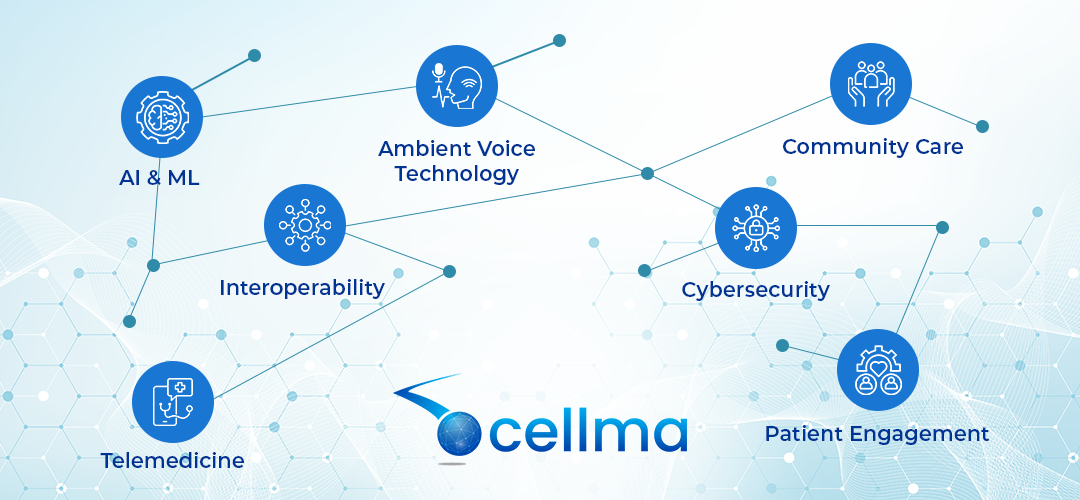
Cellma is designed to align with key EHR and EMR trends, including AI-driven insights, interoperability, automation, virtual care, patient engagement, and strong data governance. Additionally, organisations will benefit from having a modular, configurable EHR system, which can easily be adapted to their current requirements as well as the anticipated future models of providing care.
Yes. Cellma supports integrated care pathways across in-person and virtual settings, enables shared records for neighbourhood and community-based care, and integrates with external data sources for remote patient monitoring - ensuring continuity, safety, and governance across the full care continuum.